Bezos Centre for Sustainable Protein laboratories formally open at White City Campus
Senior science leaders gathered in White City Innovation District to mark the opening of the Bezos Centre for Sustainable Protein laboratories. As the European hub for the Bezos Earth Fund’s Future of Food programme, the Centre — based in Imperial College London’s White City Campus – brings together researchers, industry, investors, and policymakers to advance sustainable protein innovation.
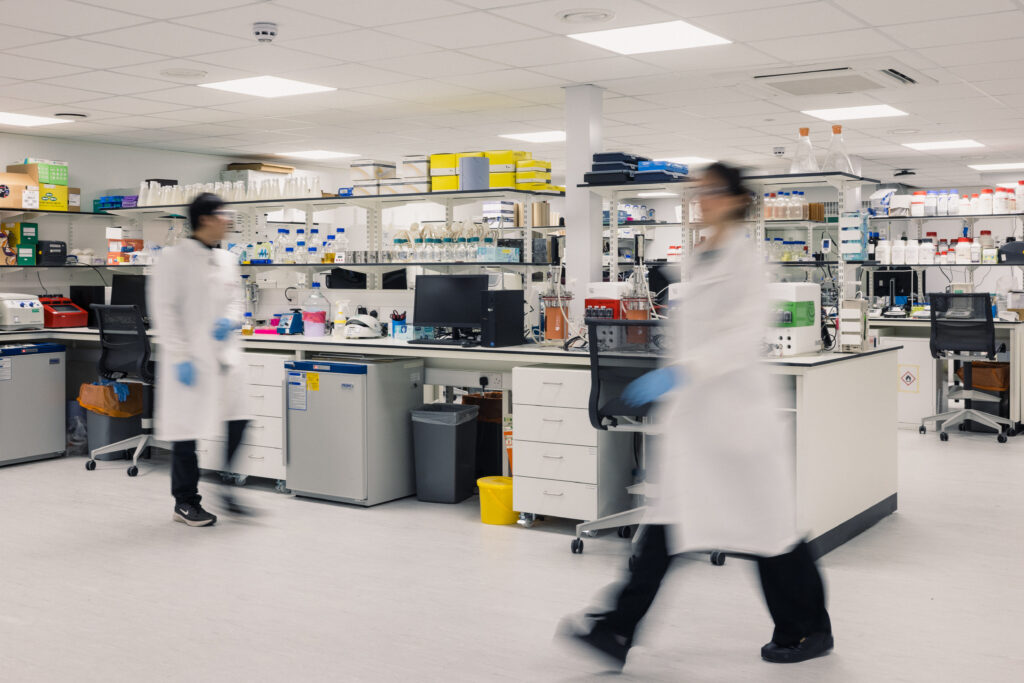
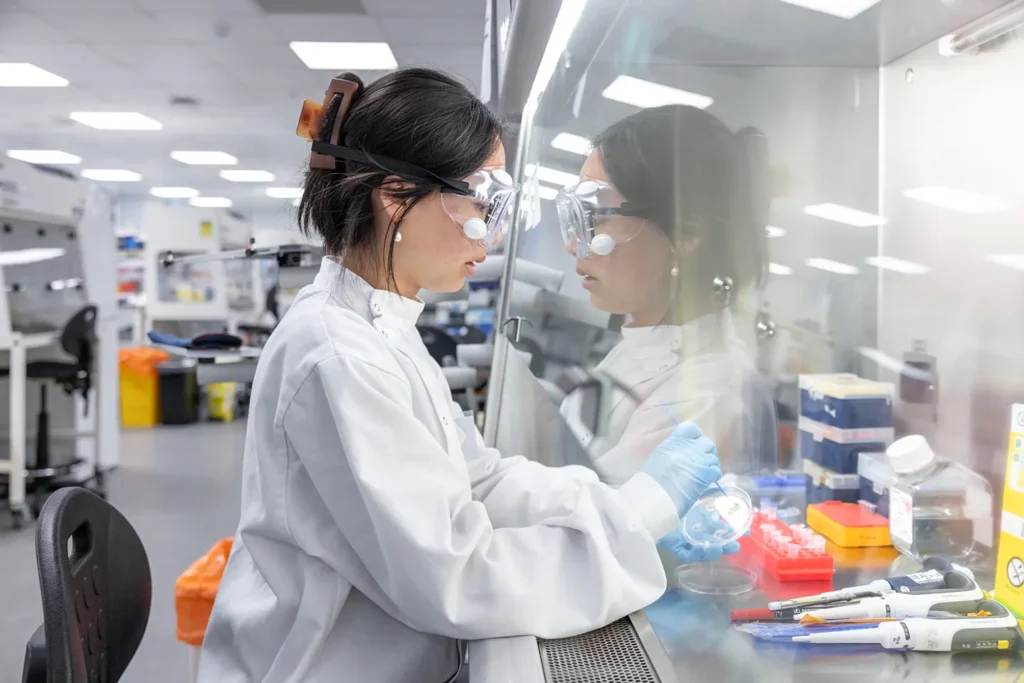
The new state-of-the-art labs provide dedicated infrastructure for developing, testing and scaling sustainable protein technologies, including the Microbial Food Hub, strengthening Imperial’s work in microbial and fermentation‑based approaches. Designed as interconnected spaces, the facility supports the full research and translation pipeline – from cell banking to scale‑up and commercialisation.
By advancing sustainable protein research, the Centre aims to address climate, food security, and supply‑chain challenges while training the next generation of experts through new PhD and Masters programmes.
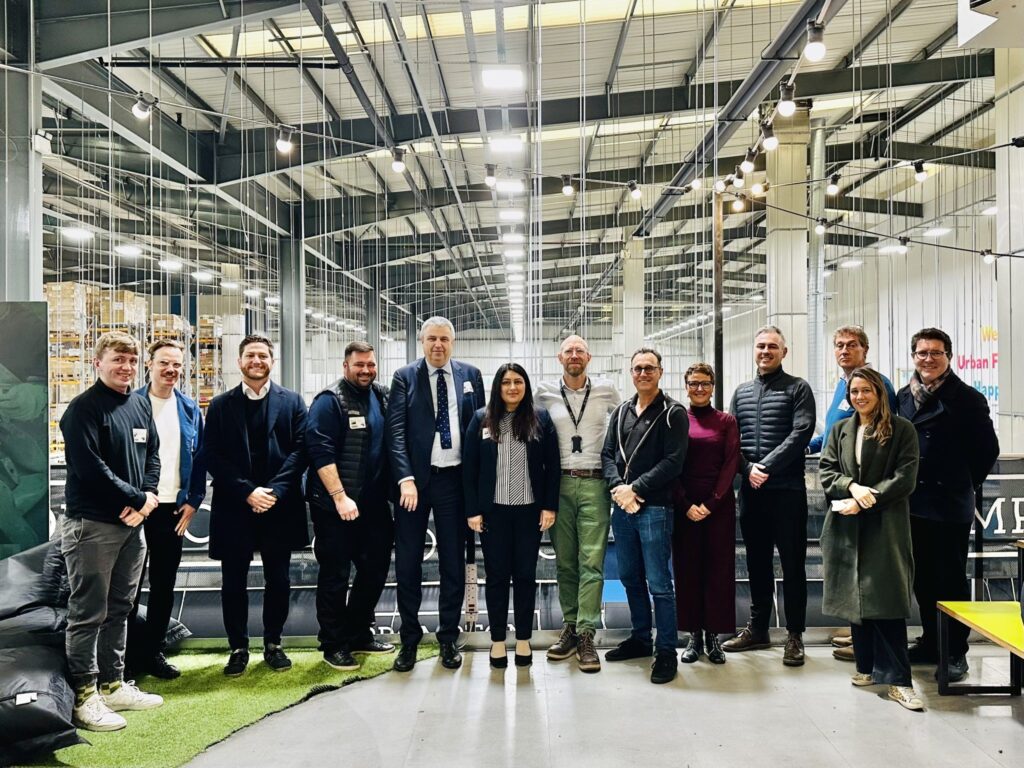
The ribbon‑cutting event brought together Imperial researchers, government representatives, regulators, and leading sustainable food startups. The event included remarks from Chief Executive of the Food Standards Agency Katie Pettifer, Deputy Chief Scientific Advisor for the Department of Environment, Food and Rural Affairs Dan McGonigle, and Chair of the Regulatory Innovation Office Lord David Willetts.
Professor Rodrigo Ledesma Amaro, Director of the Bezos Centre for Sustainable Protein, said: “The greatest challenge we face in disrupting the food system is making sustainable food cheap enough and good enough that consumers will want to eat it. Consumers are not going to select food just because it is more sustainable. It also needs to be tasty, healthy, and affordable, and it needs to be included in our culinary practices. With that in mind, we are focusing our efforts on bringing engineering biology and AI technology to food science, working with microbial food, fermentation, cultivated meat, and plant-based food to create benefit for people and for the planet.”
Professor Mary Ryan, Imperial’s Vice-Provost (Research and Enterprise), said: “At Imperial, we try hard to make integration and collaboration across disciplines as easy as possible, because we believe that’s where transformation can happen. The Bezos Centre for Sustainable Protein has been supported by the Bezos Earth Fund and built to accelerate that work here in White City. The Centre is already home to more than 160 researchers, and we now have over £60m in research funding in the sustainable protein space – all of which comes with a very clear focus on making sure that we translate this work into real-world applications.”
Dr Andy Jarvis, Director of Future of Food at the Bezos Earth Fund, said: “We need to give consumers a range of choice, wherever they go to get their food, and for that choice to be sustainable. How do we make alternative proteins tastier, cheaper and healthier? That is what we’re looking for this lab to do.”
About The Bezos Centre for Sustainable Protein
The Bezos Centre for Sustainable Protein was first announced in 2024 as part of a $100 million commitment from the Bezos Earth Fund to accelerate sustainable protein innovation and expand consumer choice in the food industry. Since then, the Centre has convened a network of more than 350 companies and stakeholders, launched over 100 research projects and brought on board 11 venture capital partners.
Spanning seven Imperial academic departments, the aim of the Centre is to advance research into precision fermentation, cultivated meat, bioprocessing and automation, nutrition, and AI and machine learning.
Operating across seven Imperial departments, the Centre advances work in precision fermentation, cultivated meat, bioprocessing, automation, nutrition, and AI‑driven approaches. Its research is already supported by industry partners including THIS, Algenuity, Fermtech, and startups within Imperial’s ecosystem such as Arborea and Meatly.
• Arborea, based in I‑HUB in White City Innovation District and founded by Imperial alumnus Julian Melchiorri, converts captured CO₂ into net‑zero protein and other ingredients for food, feed, cosmetics, and agriculture.
• Meatly, a cultivated meat company, launched the world’s first cultivated pet food in 2025 and recently raised over £10m to build Europe’s largest cultivated meat bioreactor facility in WestTech London’s Old Oak Innovation Cluster at Grapht Works – London’s first dedicated pilot and demonstration advanced manufacturing facility.
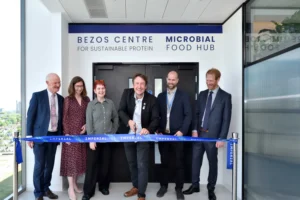
Dr Andy Jarvis, from the Bezos Earth Fund, cutting the ribbon to formally open the new laboratories.
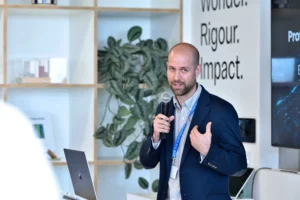
Professor Rodrigo Ledesma Amaro speaking at the opening event.
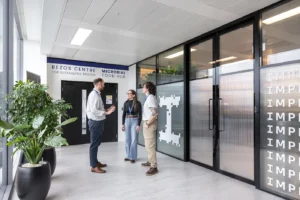
The entrance to the Bezos Centre for Sustainable Protein.